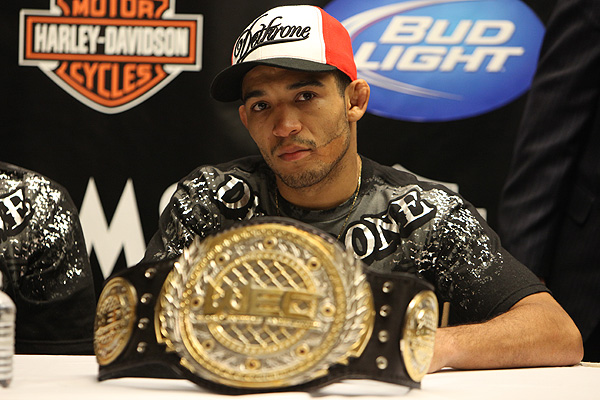

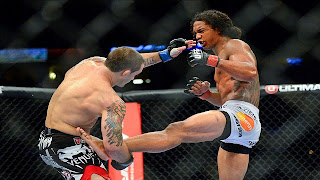


UFC 150 provided a talking point in a much larger debate that needs to take place in mixed martial arts. At the end of the night, Benson Henderson had his hand raised in his first lightweight title defense. While media pundits, fans, and fighters alike took to Twitter, Facebook, and Internet radio to proclaim Frankie Edgar the winner, their words didn’t matter because the judges had spoken. The action that we saw during the main event brought the discussion back to the effects of so-called “point fighting,” versus fighting with reckless abandon, in mixed martial arts.
Throughout the fight we saw two things happening: Henderson was winding up to land heavier shots from punches and body kicks, while Edgar was countering effectively and staying very active throughout each round. Based on Fight Metric’s numbers from the event, Edgar was the more active fighter, although not by a massive margin. Edgar landed 70 total strikes in comparison to Henderson’s 67. They also gave Edgar the edge in striking and grappling effectiveness, with scores of 243 and 28, as compared to Henderson’s 230 and 20 — interesting numbers when we look at the result of the event. But this brings into question, “What is deemed effective?”
From the judges’ point of view it would seem that “effective” would be used to describe the power strikes that Henderson was throwing and landing. This is compared to the counter combinations that Edgar was landing before he used his footwork to circle out of range. With this in mind, which version of striking should be worth more “points” when trying to award a bout to a fighter?
“Point scoring” versus “aggressive striking” has been debated in the past. Another example is when Carlos Condit fought Nick Diaz earlier this year. Condit used evasive movement and counter strikes to combat Diaz’s forward movement and volume strikes. Fans, media, and fighters still argue about the outcome of that bout. However, regardless of where you stood then, or stand now, the fact remains that striking that is based on “point scoring” is going to be an element of MMA, just as it is with every other combat sport. It is the perception that the community has of that element that may need adjusting.
Some fighters are going to stand in the pocket to exchange punches in bunches, looking to land the blow that brings about the end of their fights. Dan Henderson, Donald Cerrone, Nick Diaz, and Chan Sung Jung are examples that stand out as fighters highly-ranked in their respective divisions who use this style. On the other hand, you have fighters that use the opposite style to win their bouts; Edgar, Dominick Cruz, and Lyoto Machida are a few names who spring to mind.
 The conversation is always going to come back to the question about which style is more effective. The answer is neither; perception is key. Can you honestly say that Edgar was less aggressive during the bout because he was circling in and out while counter punching? What about saying that Nate Diaz was looking to only score points as he outstruck Cerrone during their fight last year? In essence, this is what some judges may see as they score these bouts, and the depth of their misunderstanding about what is going on in the cage is causing judging problems to become more and more prevalent.
This isn’t the first decision that has brought about a backlash in MMA, and it won’t be the last. Fighters shouldn’t be forced to subject themselves to higher degrees of damage just to win over some judges, nor should they forego using fighting strategies that fit their skill sets. Instead, the judges who are charged with evaluating these fights need to become more educated about what they are truly watching, which isn’t necessarily easy to implement, but nonetheless, needs to happen. Mixed martial arts is still in its infant stages when you compare it to boxing and other combat sports. But its growth can be still be hampered by the negative impact that judging has had on those sports. The powers that be within this sport need to come together and figure out a way to correct the issue soon, because regardless of whether fighters seek to score points or aggressively fight for the finish, the judges need to get it right, period.